The short answer: Sift 3g of matcha into a bowl and whisk it with 50 to 60ml of water at 75 to 80°C until smooth and foamy. For a hot latte, pour in 150 to 180ml of milk steamed to about 60°C. For an iced latte, fill a glass with ice and cold milk, then pour the matcha over the top. Never put matcha powder straight into milk, and never use boiling water.
Most people's first bowl of matcha is a disappointment. It is bitter, it is lumpy, there is a green film floating on top, and it tastes nothing like the latte they had at a cafe. Then they decide matcha is not for them, or that the tin they bought must be bad. Almost always, neither is true. Matcha is one of the easiest drinks in the world to make well and one of the easiest to make badly, and the difference comes down to four things: water temperature, the amount of powder, whether you sifted it, and how you whisked it.
This guide walks through those four things properly, then shows you how to turn the same bowl into a hot or iced matcha latte that tastes like the good cafes across the UAE. It is written for someone who has just opened their first tin. If you are still deciding what to buy, start with our complete guide to matcha or the shorter ceremonial vs culinary piece, then come back here.
- Which matcha do you have?
- What you actually need
- Water temperature
- How much matcha to use
- Sift it. Every time.
- How to whisk matcha
- How to make a matcha latte
- Iced matcha latte
- No whisk? What works and what does not
- Storage and freshness
- Looking after your whisk
- Troubleshooting
- FAQ
First, which matcha do you have?
The method in this guide works for any real Japanese matcha, but the ratios and the expectations shift a little depending on the grade.
Ceremonial grade is made from first-harvest, shade-grown leaves with the stems and veins removed before stone-grinding. It is naturally sweet with a savory umami depth and very little bitterness, which means you can drink it with just water and it tastes good. Our Era Ceremonial Matcha from Uji is this grade, and it is what every measurement below assumes. It comes in a 30g tin, which makes 10 to 15 bowls, and a 100g tin for daily drinkers.
Culinary grade comes from later harvests and is ground coarser. It is more bitter and more astringent, which is fine when it is buried in a cake or a smoothie but rough on its own. If that is what you have, it will still make a decent latte with milk and a little sweetener. Just do not judge matcha by drinking it straight.
If your tin is hojicha, which is roasted tea powder rather than green matcha, every step here still applies. Hojicha is more forgiving of hotter water and makes a particularly good latte, so it is a kind introduction if you find matcha's grassiness takes getting used to.
One quick check before you start: real matcha is a vivid, almost electric green. If your powder is dull, yellowish or brownish-green, it is either old, low grade, or has been stored badly, and no technique will fully rescue it.
What you actually need (and what you do not)
You can make good matcha with very little. Here is what matters, in order of how much difference it makes.
- A bamboo whisk (chasen). This is the one tool that has no real substitute for a traditional bowl. The 100 fine prongs do two jobs at once: they break up the powder so it dissolves evenly, and they beat air in to create the soft foam that makes matcha taste smooth instead of chalky. Our Era White Bamboo Chasen is the one to start with. The dark bamboo version is the same prong count in a harder, longer-lasting bamboo. Skip the Sumi professional whisk for now. Its prongs are much finer and they snap under a heavy beginner's hand.
- A way to measure. A small kitchen scale that reads to 0.1g is the most accurate. If you do not have one, the Era Matcha Scoop holds exactly 3g, which is one latte, and a traditional bamboo chashaku holds about 1g per scoop, so two scoops make one bowl.
- A sifter. Any fine mesh tea strainer works. The Furui sifter is sized for a bowl, and the Sieve and Storage Canister sifts and stores the whole tin airtight in one piece, which solves two problems at once in UAE humidity.
- A bowl. A proper matcha bowl (chawan) is wide and shallow with a flat-ish bottom, which gives the whisk room to move. Any wide cereal bowl or large mug will work on day one. When you want the real thing, the Tsuchi bowls are our everyday range and the Shin bowls are the step up.
- Something to control water temperature. A kettle with a temperature setting is ideal. If yours only boils, see the next section for the workaround. You do not need to buy anything.
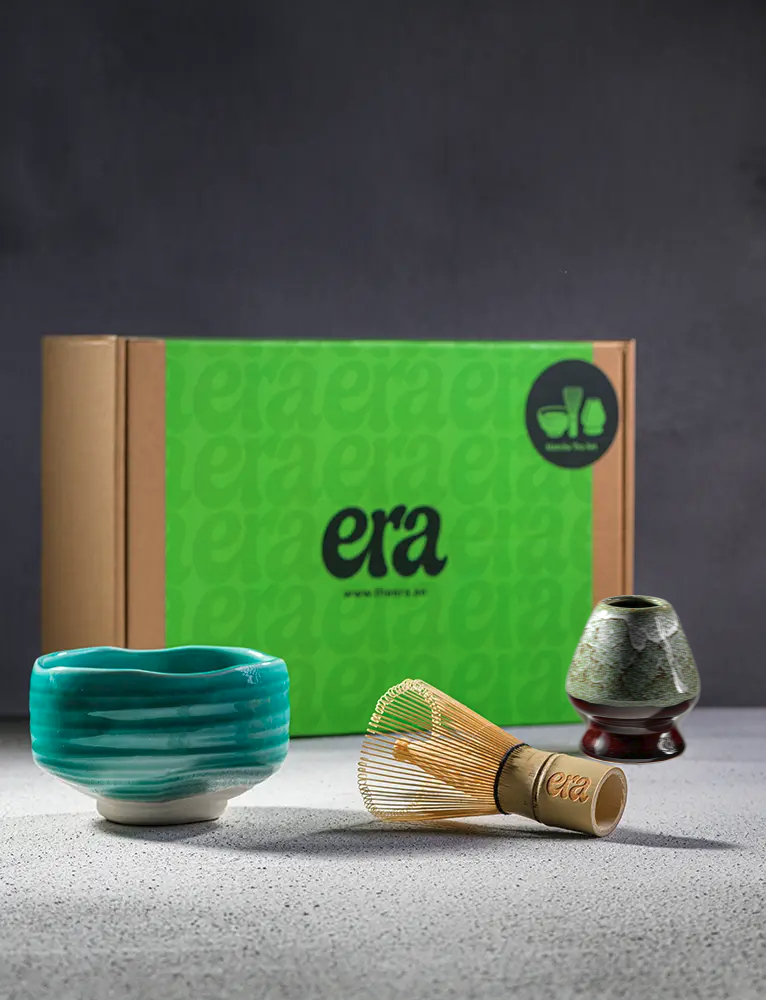
If you would rather buy it all at once, each of our Matcha Ritual Sets is a bowl, a 100-prong whisk and a ceramic holder in matched glazes, with the matcha sold separately.
What you do not need: a bamboo ladle, a tea cloth, a cast iron kettle, or anything else that looks nice in photos. Those belong to the tea ceremony, which is a different thing from making yourself a good drink in the morning.
Water temperature: the mistake that ruins most first bowls
If your matcha tastes bitter, this is almost certainly why. Matcha is whole tea leaf, and like any green tea it releases bitter catechins and astringent tannins very quickly in boiling water. The sweetness and umami come out at lower temperatures. So the rule is simple:
Use water between 70 and 80°C. Never boiling.
For ceremonial grade drunk straight, aim for the lower end, around 70 to 75°C, where the sweetness is most obvious. For a latte concentrate that will be diluted with milk, 75 to 80°C gives a slightly stronger, more tea-forward shot that holds up against the milk.
If your kettle does not have a temperature setting, boil it, then either leave the lid open for four to five minutes, or pour the boiling water into a cold cup, let it sit for a minute, then pour it from that cup into your bowl. Each transfer drops the temperature by roughly 10°C. After a few days you will do this by habit.
Use filtered water. UAE tap water is hard and the minerals flatten matcha's flavor and make the foam coarser. The same filtered or bottled water you would use for coffee is right for matcha.
How much matcha to use
Two numbers cover almost everything:
- 2g for a traditional bowl (called usucha, or thin tea), whisked with 60 to 70ml of water. This is the classic way to drink ceremonial matcha and the best way to taste what you paid for.
- 3g for a latte, whisked with 50 to 60ml of water into a concentrate, then topped with 150 to 180ml of milk. One level Era scoop is exactly this.
Beginners nearly always use too much. A heaped teaspoon is 4 to 5g, which is double a traditional serving, and that is the second most common reason a first bowl tastes harsh. Weigh it for the first week. Once you know what 2g looks like in your scoop you can stop.
Resist the urge to fix a bitter bowl by adding more powder. More matcha in hot water means more bitterness, not less. Fix the water temperature first, then the sift, then the dose.
Sift it. Every time.
Matcha is ground so fine that static and humidity make it clump into tiny pellets inside the tin. Those pellets will not break up in water no matter how hard you whisk, and they are the green lumps and the gritty texture people complain about. Sifting takes ten seconds and removes the problem completely.
Put your sifter over the bowl, add the matcha, and push it through gently with the back of the scoop or a small spoon. What falls through should look like a soft, even layer of powder with no lumps. If you are using the Sieve and Storage Canister, the sifting happens as you tap the powder out.
In the UAE this step matters more than it does in a dry climate. Even a tin that was perfectly loose in Kyoto will have started to clump by the time it has been opened a few times in a UAE kitchen in August.
How to whisk matcha
This is the part people overthink. It takes about twenty seconds once you have the motion.
- Soak the whisk first. Pour a little of your hot water into the empty bowl, rest the whisk prongs in it for 20 or 30 seconds, then pour the water away and dry the bowl. This softens the bamboo so the prongs flex instead of snapping, and it warms the bowl. Do this every time.
- Sift in your 2g of matcha (or 3g if you are making a latte).
- Add a splash of water first, not all of it. About a tablespoon. Use the whisk to work it into a smooth, dark green paste with no dry spots. This is the step that prevents lumps better than anything else.
- Add the rest of the water, 60 to 70ml for usucha, 50 to 60ml for a latte concentrate.
- Whisk fast in a W or M motion, back and forth across the bowl, using your wrist rather than your whole arm. Do not stir in circles. Circles move the liquid around; the zigzag motion beats air into it. Keep the prongs just off the bottom of the bowl rather than scraping it. Fifteen to twenty seconds of brisk whisking is enough.
- Finish by slowing down, drawing the whisk gently across the surface to break any large bubbles, then lift it straight up out of the center. You should have a layer of fine, even foam with no bare liquid showing through.
Drink it straight from the bowl while it is warm. If it tastes good, slightly sweet, savory and smooth with no harshness, you are done. That is the baseline everything else builds on.
If you ever want to try koicha (thick tea), it is 4g of matcha to about 30ml of water, kneaded slowly rather than whisked. It is intense, almost syrupy, and only worth doing with a top ceremonial grade. Treat it as something to try once you are comfortable, not somewhere to start.
How to make a matcha latte the right way
The single biggest mistake with lattes is putting matcha powder straight into milk. It does not dissolve properly in milk, it clumps, and you end up stirring a gritty cup for five minutes. Every good matcha latte, including the Kyoto-style ones, is made in two stages: a small, strong matcha concentrate whisked with hot water, then milk added to it.
- Make the concentrate. Sift 3g of matcha into your bowl, add 50 to 60ml of water at 75 to 80°C, and whisk exactly as described above until it is smooth and foamy. This is your shot, and it is the same for hot and iced.
- Sweeten it now, if you want to. If you take your latte sweet, dissolve the sweetener into the hot concentrate rather than the cold milk. Half a teaspoon of honey, maple syrup or a simple syrup is plenty for most people. Good ceremonial matcha with oat milk often needs none at all.
- Prepare the milk. You want 150 to 180ml, heated to around 60°C and textured into a smooth microfoam. Hotter than that and the milk starts to taste cooked and flattens the matcha. If you have an espresso machine, steam it as you would for a flat white. If you do not, a NanoFoamer in a jug of milk warmed on the stove or in the microwave gives you proper microfoam in about 20 seconds. A handleless jug like the Timecore lets you feel the temperature with your palm, which is how baristas do it.
- Combine. Pour the concentrate into your cup, then pour the milk into it steadily from a low height. The foam settles on top and the color comes out an even, pale green. For a layered look, do it the other way: milk first, then pour the concentrate slowly over the back of a spoon.
Which milk? Barista-style oat milk is the easiest to get right and gives the best color and body, which is why most cafes use it. Whole dairy milk is richer and steams beautifully but slightly mutes the matcha. Almond and coconut are thinner and tend to separate; they work better iced than hot. Avoid low-fat milks for a hot latte, they foam badly and taste watery against the tea.
A note on ratios: cafes vary between 1 part concentrate to 3 or 4 parts milk. The 3g, 50ml, 170ml recipe above lands in the middle. Once you have made it a few times, nudge the matcha up to 4g if you like it stronger, and remember that if you reduce the milk you should reduce the matcha too, otherwise it will taste bitter even at the right water temperature.
Iced matcha latte
In the UAE this is the one you will make most of the year, and it is actually simpler than the hot version because there is no milk to texture.
- Make the same 3g concentrate with 50 to 60ml of water at 75 to 80°C. Do not skip the hot water. Whisking matcha into cold water alone works for a basic drink but you lose the sweetness and the foam.
- Fill a tall glass with ice. Not a few cubes, a full glass. The ice does the chilling and the dilution together.
- Pour in 150 to 180ml of cold milk, straight from the fridge.
- Pour the concentrate slowly over the top. It sits on the milk in a green layer and then marbles down as you stir. Stir or shake just before drinking.
If you like it sweeter, stir the sweetener into the hot concentrate before it goes over the ice, exactly as with the hot latte. Sweetener added to cold milk never dissolves properly.
For the glass, double-walled borosilicate keeps it cold without sweating all over your desk. Our Kumo Cup is 250ml, which is right for a single iced latte at home, and the KeepCup Cold Cup with its wide straw is the one for the car or the office.
No whisk? What works and what does not
You can absolutely make a matcha latte without a chasen. Be honest with yourself about what you are trading away.
- Electric milk frother or NanoFoamer: works well for the concentrate step. Sift 3g into a cup, add the hot water, froth for 10 to 15 seconds. It dissolves the powder and makes foam. It is actually the fastest method for lattes. It is less good for a traditional bowl because the foam is coarser and the flavor comes out slightly flatter.
- A shaker bottle or jar with a lid: sifted matcha plus hot water, shake hard for 20 seconds. Fine for iced lattes. Make sure the lid is on properly; hot water in a sealed bottle builds pressure.
- A blender: the Beast GO or any small blender makes an excellent iced matcha latte if you blend the concentrate, milk and ice together. This is how a lot of cafes do their frappes. It is overkill for a hot drink.
- A fork or a spoon: does not work. You will get lumps and no foam. If this is all you have, make the paste step very carefully and accept a rustic result.
The whisk is the cheapest upgrade you can make to your matcha and it lasts a year or more with care. If you are only ever going to drink lattes, the frother route is legitimate. If you want to taste ceremonial matcha the way it was meant to be drunk, get the whisk.
Storage and freshness
Matcha is more perishable than coffee beans and far more perishable than tea leaves. Being ground to a powder means a huge surface area exposed to air, light, heat and moisture, and all four degrade it. The color fades from bright green to olive, the sweetness goes, and the bitterness comes forward. In the UAE, where kitchens run warm and humid, this happens faster than the packaging suggests.
The answer is simple: keep your matcha in the fridge, opened or unopened. Ours stays refrigerated from stone-grinding until it is packed for you, and it should stay that way at home.
- Unopened: keep the sealed tin in the fridge. It will hold for many months this way.
- Once opened: keep it in the fridge too, and aim to finish it within four to eight weeks. This is why we sell the 30g tin: a daily drinker gets through it in two to three weeks and never drinks stale matcha.
- Every time you use it: take the tin out with the lid closed and let it sit on the counter for 20 to 30 minutes before you open it. Opening cold matcha in a warm room pulls moisture onto the powder, which causes clumping. Scoop with a dry spoon, close the lid straight away, and put it back in the fridge.
- Never leave it in a tin with the lid loose, in a clear container on a sunny counter, near the kettle, or out of the fridge through a UAE summer.
The Sieve and Storage Canister exists for exactly this: 304 stainless steel, airtight, holds a full 100g tin, and sifts as you dispense so the powder spends the least possible time exposed.
Looking after your whisk
A bamboo whisk is a consumable, but a cared-for one lasts far longer than a neglected one. Four habits:
- Soak before every use, as described in the whisking section. Dry bamboo is brittle bamboo.
- Rinse immediately after in warm water, no soap, swishing it in a bowl of clean water rather than under a hard tap. Never put it in the dishwasher.
- Dry it on a holder. Left on its side or face down in a drawer, the prongs close inward and the whisk loses its shape within weeks. A ceramic holder like the Kata keeps the prongs splayed and lets air circulate so it dries without mold. This is the single biggest factor in how long a whisk lasts.
- Expect it to change. New whisks arrive with the prongs curled tightly inward. They open out over the first few uses; that is normal. When prongs start breaking off regularly, usually after six months to a year of daily use, it is time to replace it.
Troubleshooting your first week
- Bitter or astringent. Water too hot. Drop to 70 to 75°C. If it is still bitter at the right temperature, you are using too much powder, or the matcha is culinary grade or old.
- Lumps and grit. You skipped the sift, or added all the water at once. Sift, then make the paste with a splash of water before adding the rest.
- No foam. Whisking in circles instead of the zigzag, whisking too slowly, or too much water for the amount of matcha. Try 2g to 60ml, fast W motion, wrist only.
- Green film or residue on the bowl. Normal in small amounts. A lot of it means the powder did not dissolve, which goes back to the sift and the paste step.
- Latte tastes watery or barely green. Too little matcha for the amount of milk, or the concentrate was made with too much water. Keep the concentrate to 50 to 60ml and use the full 3g.
- Latte tastes grassy and harsh. Either the water for the concentrate was boiling, or you used a culinary grade. Milk hides a lot but not everything.
- Iced latte separates into layers that will not mix. That is the oil in some plant milks. Shake or stir harder, or switch to a barista-style oat milk which is formulated not to split.
- Matcha tastes dull and smells like hay. It is past its best. Check how long the tin has been open and how it was stored.
- Whisk prongs snapping. You are not soaking it first, or you are pressing down onto the bottom of the bowl. The prongs should skim the liquid, not scrub the ceramic.
Questions new matcha drinkers ask
Why is my matcha bitter?
Nine times out of ten the water was too hot. Matcha releases its bitter compounds quickly above 80°C and its sweetness below it. Use water at 70 to 80°C, never boiling. If it is still bitter, you are using too much powder (2g for a bowl, 3g for a latte) or the matcha is culinary grade or has gone stale.
What temperature should the water be for matcha?
70 to 80°C. Use the lower end for drinking matcha straight and the upper end for a latte concentrate. If your kettle only boils, let it stand with the lid open for four to five minutes, or pour it through a cold cup first.
How much matcha should I use per cup?
2g for a traditional bowl with 60 to 70ml of water, 3g for a latte with about 170ml of milk. A heaped teaspoon is 4 to 5g, which is too much. Weigh it until you know what the right amount looks like.
Do I really need to sift matcha?
Yes, every time. Matcha clumps in the tin from static and humidity, and those clumps will not break up in water. Sifting takes ten seconds and is the difference between smooth matcha and gritty matcha. In the UAE's humidity it matters even more.
Can I make a matcha latte without a whisk?
Yes. A handheld milk frother or NanoFoamer dissolves the concentrate well and is the fastest method for lattes. A shaker bottle works for iced drinks. A fork does not work. For a traditional bowl, nothing replaces the bamboo whisk.
Why does my matcha latte have lumps?
Because the powder went straight into milk. Matcha does not dissolve in milk. Always whisk it into a small amount of hot water first to make a smooth concentrate, then add the milk.
What is the best milk for a matcha latte?
Barista-style oat milk gives the best color, body and foam, which is why most cafes use it. Whole dairy milk is richer but slightly mutes the tea. Almond and coconut work better iced than hot. Avoid skim milk, it foams badly and tastes thin.
Should I sweeten matcha?
Good ceremonial matcha with water needs nothing. For a latte it is personal taste. If you do sweeten, dissolve honey, maple or syrup into the hot concentrate rather than the cold milk so it actually mixes in.
How long does matcha last once opened?
Four to eight weeks at its best, sealed and kept in the fridge. It does not go off, but the color dulls and the flavor flattens. Buy the 30g tin if you drink it a few times a week and the 100g if you drink it daily.
Should I keep matcha in the fridge?
Yes, opened or unopened. In the UAE the fridge is the safest place for matcha. Let the sealed tin sit on the counter for 20 to 30 minutes before you open it, use a dry scoop, and close it straight away.
How much caffeine is in a bowl of matcha?
A 2g serving has roughly the caffeine of a single espresso, released more gradually because of the L-theanine naturally present in the leaf. A 3g latte has a bit more. Hojicha has noticeably less because roasting reduces it.
Can I use ceremonial matcha for lattes, or is that a waste?
Use it. Ceremonial grade makes a smoother, sweeter latte with better color and needs less or no sugar. Culinary grade is for baking. The idea that lattes should use lower grade matcha comes from cafe cost control, not from flavor.
How do I know if my matcha is good quality?
Color first: it should be a bright, vivid green, not olive or yellowish. Then smell: fresh and sweet, a little like cut grass or spinach, never like hay. Then taste with water at 75°C: smooth and savory with natural sweetness and only a faint, pleasant bitterness at the end.
If you are stuck on any of this, send us a message with a photo of your bowl and the water temperature and dose you used. It usually takes one reply to fix. Everything mentioned above is in our matcha accessories collection, and the matcha itself is in Uji matcha.