By The Era Store, small-batch specialty roasters in Dubai and suppliers of ceremonial grade Uji matcha.
Decaf used to be the coffee people settled for, the one at the bottom of the menu. That's changed.
A good decaf today starts as the same high-grown specialty coffee as any other bag on our shelf. The caffeine comes out, most of the flavor stays, and you can have an espresso after dinner again. This guide covers how that works, how much caffeine is really left, and one thing that doesn't get explained much: decaf behaves a little differently in an espresso machine, and you'll want to adjust your grind for it. Pick the question you came for, or read it top to bottom.
Jump to Your Question
- How is decaf made?
- Caffeine in a decaf espresso
- Does decaf taste different?
- Why it's roasted for espresso
- Dialing in decaf espresso
- Decaf in milk drinks
- Half-caf
- Resting and storage in the UAE
- When decaf makes sense
- The decaf we roast
- FAQ
How Is Decaf Coffee Made?
Every decaf starts as ordinary green coffee. The caffeine is removed from the raw bean, long before it reaches a roaster, and every method works on the same idea: soak the beans so the caffeine can move out, then separate the caffeine from everything else.
There are three families of method. Solvent processes use a food-safe solvent that bonds with the caffeine and carries it away. Carbon dioxide processes do the same job with pressurized CO2, mostly at very large volumes. Water processes use only water, temperature, time, and carbon filters. All three are regulated and considered safe. The differences you'll notice are in flavor and in what the beans were soaked in.
Ours is decaffeinated with the Swiss Water process, and this is how it works.
1. The soak. Green beans are soaked in clean water so they swell and open up.
2. The extract. The beans are moved into green coffee extract, which is water already saturated with the soluble flavor compounds found in coffee, but with no caffeine in it.
3. The exchange. Because the extract is already full of flavor, the flavor inside the beans has nowhere to go. The caffeine does, so it moves out of the bean and into the liquid.
4. The filter. The liquid passes through carbon filters that trap the caffeine, then circulates back over the beans. This carries on for eight to ten hours.
5. The finish. The beans are dried and shipped to the roaster 99.9% caffeine-free, with their sugars and oils still in place.
No solvents are added at any stage, which is why it's described as chemical-free. For the longer story, including how the other methods compare, see the decaf section of our complete guide to specialty coffee.
How Much Caffeine Is in a Decaf Espresso?
Decaf isn't zero caffeine. A Swiss Water decaf espresso carries a few milligrams per shot, against roughly 60 to 80mg in a regular one. For most people that trace amount makes no difference, so you can have a late coffee and still sleep.
If you're avoiding caffeine for medical reasons or during pregnancy, decaf is a real option, but check with your doctor first.
Does Decaf Taste Different?
Slightly, and less than you'd expect. Any decaffeination process softens some of the brightest top notes, so a decaf will rarely be the most floral, citrusy coffee on the table. Sweetness and body come through well, along with the deeper flavors like chocolate, nuts, and brown sugar.
That's why the coffee that goes in matters so much. A carefully grown, high-altitude lot still tastes like itself once the caffeine is gone. A tired one tastes tired either way.
Why Is This Decaf Roasted for Espresso?
We roast our Colombia Cacao Velvet Decaf for one job: espresso, straight or with milk. It's a medium roast, developed to bring sweetness forward and give the shot a round, heavy body. Cacao, praline, and brown sugar suit a short, intense extraction, and they carry through a flat white.
It's also how most people drink decaf: the espresso after dinner, the late cappuccino. We'd rather roast one decaf that's excellent at that than one that's average at everything. If you brew pour over or French press, the filter roasts among our specialty beans are the better shelf. The difference is explained in the coffee categories section of our guide.
How Do You Dial In Decaf Espresso?
Decaf behaves a little differently in an espresso machine. Knowing how saves you a few wasted shots.
1. Start with the classic recipe. 18g of ground coffee in, around 36g of espresso out, in 25 to 30 seconds. That's a 1:2 ratio, the same starting point we'd give you for any of our espresso roasts.
2. Expect to grind finer. Decaffeination leaves beans slightly more brittle and porous, so water runs through them faster at the same grind setting. If your first shot gushes out in 18 seconds and tastes thin or sharp, that's normal. Go one or two steps finer and pull again.
3. Purge when you switch. If regular and decaf share one grinder, a few grams of the last coffee are still sitting in the burrs. Run a little decaf through and throw it away before you dose. Otherwise your evening decaf is part regular.
4. Don't judge it by the crema. Decaf tends to pour with a thinner, paler crema that fades sooner. It's a side effect of decaffeination and doesn't mean the beans are old. Go by taste.
5. Change one thing at a time. Sour, sharp, or thin means under-extracted, so grind finer. Bitter, harsh, or drying means over-extracted, so grind coarser. Taste, adjust, taste again.
One more thing that surprises people: decaf beans often look a shade darker than regular beans at the same roast level, sometimes with a slight sheen. That's normal after decaffeination and says nothing about the roast or the freshness.
All of this works on any home machine, from a Sage with a built-in grinder to a separate grinder and machine. If you're still choosing one, our guide to home espresso machines will help.
Is Decaf Good in Flat Whites and Lattes?
This is where it's most at home. Milk mutes delicate florals and brings out chocolate, nuts, and caramel, which is what this coffee is made of. Pull the same 1:2 shot, texture your milk as usual, and the cacao and brown sugar come straight through.
If your milk drinks taste washed out, the fix is almost always the shot. Tighten the grind slightly so the espresso is a touch more concentrated before the milk goes in.
What Is Half-Caf, and How Do You Make It?
Half-caf is what it sounds like: half regular beans, half decaf, in the same dose. For an 18g basket that's 9g of each, weighed, straight into the grinder together. You cut the caffeine in every cup by half and nothing else about your routine changes.
It works best when the two coffees taste alike. Our decaf alongside Brazil Vale Dourado is a natural pairing, with chocolate and nuts on both sides. Expect your grind setting to land somewhere between where each coffee sits on its own.
How Should You Rest and Store Decaf in the UAE?
Decaf follows the same freshness rules as every coffee we roast. Because the beans are slightly more porous after processing, good storage matters even more.
Rest it first. Espresso is at its best roughly 7 to 14 days after the roast date, once the beans have finished releasing carbon dioxide. Brewed too early, shots can taste hollow and pour unevenly. The roast date is printed on every bag.
Keep it sealed, dark, and cool. In the bag it came in or an airtight canister, in a cupboard away from the oven, the kettle, and the window. In a UAE kitchen that matters more than almost anywhere else.
Skip the fridge. Daily trips in and out cause condensation, and roasted beans absorb food smells.
Never leave it in the car. A parked car in a UAE summer is an oven. Twenty minutes in there can ruin a bag.
Buy the size you'll finish. For peak flavor, drink a bag within about a month of its roast date. If decaf is your occasional evening cup, the 200g bag is the right call. If it's your daily coffee, go for 500g. If you're making half-caf for a household or the office, the 1kg bag is the better value.
Grind only what you need. Ground coffee goes stale in minutes. Whole beans and a fresh grind do more for your cup than any other habit.
When Does Decaf Make Sense?
The espresso after a late dinner, when you want the ritual and still want to sleep. The third or fourth cup of the day, when you're after the taste and don't need the caffeine. The months when you're cutting back but don't want to give up coffee. And the guest who loves coffee but is sensitive to caffeine.
About the Decaf We Roast at Era
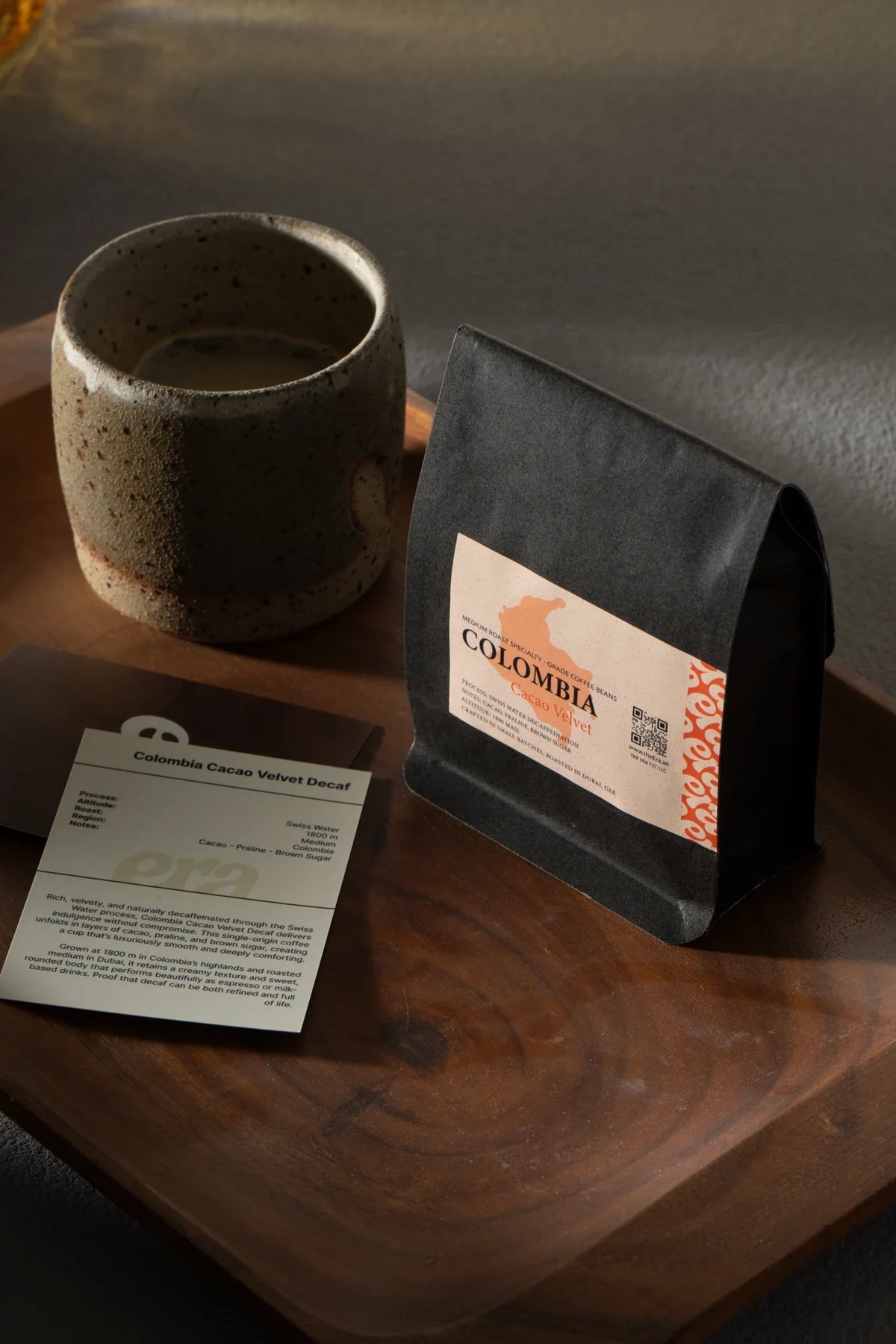
Colombia Cacao Velvet Decaf is a single origin coffee grown at 1,800 meters in Colombia's highlands, decaffeinated with the Swiss Water process, and roasted medium here in Dubai in small batches. In the cup you get cacao, praline, and brown sugar, with a creamy texture and a rounded body. It's smooth and sweet as a straight espresso, and it holds up in milk.
It comes as whole beans in 200g, 500g and 1kg bags, each with the roast date printed on it. If decaf is part of your routine, a subscription delivers a fresh roast every week, every two weeks, or every month, so the next bag arrives before the last one runs out.
Frequently Asked Questions
Is Swiss Water decaf chemical-free?
Yes. The Swiss Water process uses only water, temperature, time, and carbon filtration to remove the caffeine. No solvents are added at any stage.
How much caffeine is in a decaf espresso?
A few milligrams per shot, compared with roughly 60 to 80mg in a regular espresso. Swiss Water decaf is 99.9% caffeine-free, so it isn't completely caffeine-free.
Can I use decaf beans in a Sage or any home espresso machine?
Yes. Treat them like any other whole bean espresso roast. Start at 18g in and 36g out in 25 to 30 seconds, and expect to grind one or two steps finer than you would for regular beans.
Why does my decaf espresso run so fast?
Decaffeinated beans are slightly more brittle and porous, so water passes through them more quickly at the same grind setting. Grind finer until the shot takes 25 to 30 seconds.
Can I brew this decaf as filter coffee?
It's roasted for espresso and milk drinks, and that's where it tastes best. For pour over, French press, or batch brew, choose one of our filter roasts instead.
Is decaf less acidic than regular coffee?
Not really. Decaffeination doesn't remove acidity, and origin and roast level matter far more. A medium roast Colombian like ours is naturally smooth.
What is half-caf?
Half regular beans and half decaf in the same dose, for example 9g of each in an 18g basket. You halve the caffeine in every cup without changing your routine.
Ready for the evening espresso? Try Colombia Cacao Velvet Decaf, freshly roasted in small batches. New to specialty coffee? Start with our complete guide. And if you're choosing a machine, read the home espresso guide.