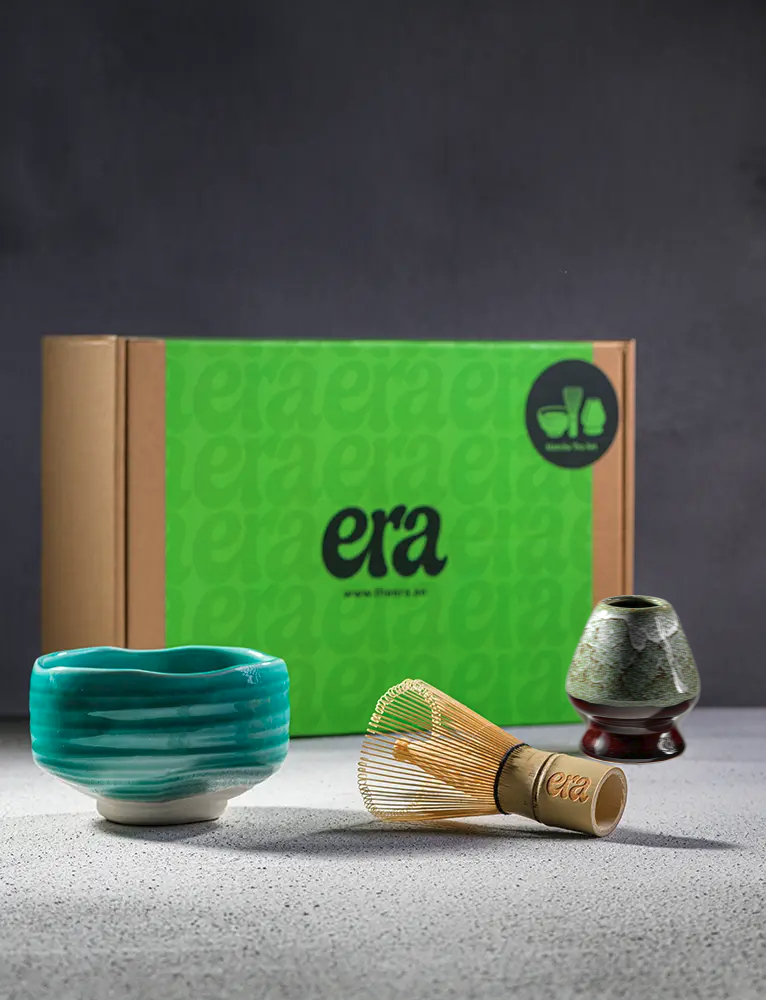
Yōhen Series (窯変) — Kiln-Born Matcha Bowl
Couldn't load pickup availability
Complete your matcha ritual
Everything you need to whisk at home
-
Era Ceremonial Matcha Powder - Uji, KyotoCeremonial grade matcha from Uji, Kyoto160 AED
-
Era Matcha ScoopMeasures 3g, exactly one bowl55 AED
-
Furui (篩) — Era Matcha SifterSifts out clumps for a smoother bowl85 AED


Yōhen means kiln transformation. It is the moment the potter's work ends and the fire takes over. Inside the kiln, heat and atmosphere move across the glaze in ways no one can direct, so the surface that comes out was never drawn, never planned and can never be repeated. The bowl you receive is the only one that will ever look exactly like it.
Aoishi (青石), Blue Stone
Aoishi looks like a stone pulled from a cold river. The outside is a pale stone glaze scattered with soft blue speckles and fine dark iron flecks, wrapped around a gently pinched body. Inside, a deep cobalt blue glaze pools glossy in the well and meets a dark rim. The foot is left unglazed, showing the raw dark clay and its trimming rings.
Each chawan is made in Mino, Gifu Prefecture, a pottery region with over thirteen centuries of continuous craft. The final surface is decided by the kiln. Where most ceramics are judged by consistency, Yōhen is judged by what the fire chose to do.
This is the counterpart to our Shin Series. Where Shin is composed and deliberate, Yōhen is untamed. Speckling, pooling, color shifts and tonal breaks across the glaze are not flaws. They are the record of the firing itself, held in ceramic.
Highlights
- Pale stone exterior speckled with blue, deep cobalt blue interior
- Kiln-variable glaze, so every bowl carries its own speckle pattern
- Made in Mino, Gifu Prefecture, Japan
- Unglazed clay foot with trimming rings
- Sized and weighted for daily matcha preparation with a chasen
- The photographed bowl is a close representative, not identical
Origin & Craftsmanship
Mino ware is one of Japan's oldest living pottery traditions, produced in the kilns of Gifu Prefecture for more than 1,300 years. Yōhen glazing sits at the expressive end of this tradition: the form and the glaze are prepared, then the outcome is left to the kiln. Variation between pieces is the defining feature of the series, not a deviation from it.
Overview
Overview
In the Japanese tea tradition, the glaze on a chawan is called its keshiki (景色), its landscape. It is read slowly, the way you would take in a view: where the color gathers in the mikomi (見込み), the well of the bowl, where it thins at the rim, where it meets the kōdai (高台), the foot.
Our chawan are made in Japan, most of them Mino-yaki (美濃焼) from Gifu Prefecture, where kilns have been firing for over 1,300 years. No two firings are the same, so no two landscapes are either. The bowl you receive is the only one with its exact keshiki.
Tea masters have a phrase for this: ichigo ichie (一期一会), one time, one meeting. Every bowl, like every bowl of matcha whisked in it, happens once.
How to use
How to use
Add your matcha powder to the bowl, then pour in hot water (around 75–80°C).
Use a bamboo chasen (whisk) to mix briskly in an “M” or “W” motion until a gentle froth forms on the surface.
The bowl’s curved interior allows the whisk to move freely, creating a perfectly smooth, balanced cup. Sip directly from the chawan — as is tradition — and enjoy the quiet harmony of form and flavor.
💡 Tip: For a modern twist, whisk your matcha first, then pour it over cold milk or ice for a café-style matcha latte
Care & Storage
Care & Storage
- Hand wash with warm water and mild soap.
- Not for the dishwasher or microwave.
- Dry fully, foot included, before putting away.
- Variation in color and tone is the bowl’s keshiki, not a flaw.